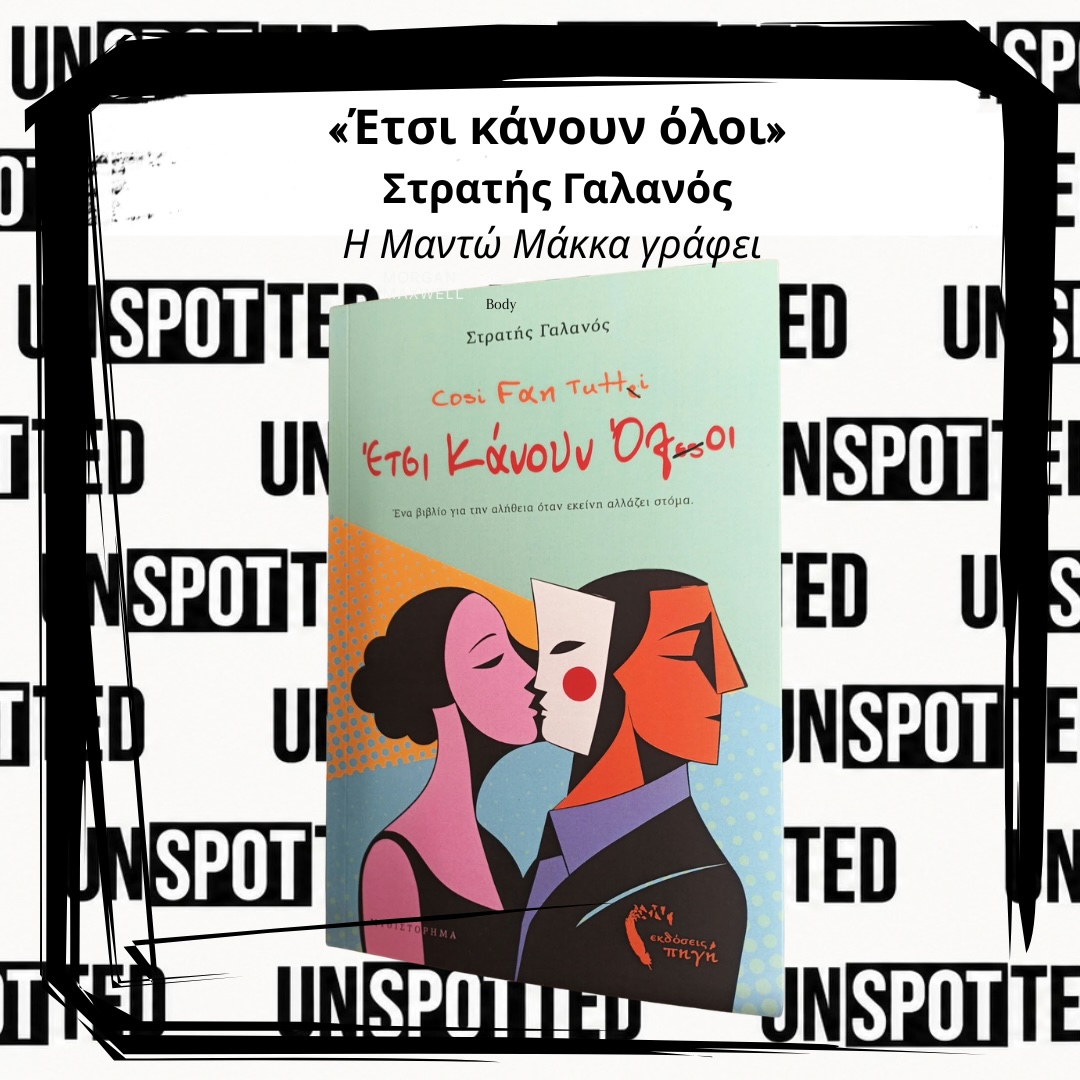
Stratis Galanos’s new book, That’s What They All Do (Così fan tutti), is a polyphonic, episodic ‘tragicomedy’ (as it aptly describes itself within the text), which moves between the psychological thriller, social drama and dark comedy. The book’s title is borrowed directly from Mozart’s celebrated opera, in which two men wager on the fidelity of their partners and disguise themselves to put them to the test. The novel constitutes a contemporary, darker variation on this motif.
The Plot: A Mutual Death Pact
The plot revolves around three men from different generations: 63-year-old criminology professor Gerasimos, 42-year-old police officer Andreas and 27-year-old postgraduate student Aris, who meet one Friday evening at Gerasimos’s house. All three have recently separated from their partners and are wounded, filled with anger, hatred and resentment towards their former partners, Vicky, Despina and Claire.
Amid their drunkenness and exchange of grievances, Aris suggests killing them. Andreas, the police officer, familiar with the workings of criminal investigations, proposes the ‘perfect crime’, inspired by Hitchcock’s film: exchanging murders. Each man will kill another’s former partner so that there is no obvious motive linking them to the crime. Andreas supplies them with a supposed poison (potassium chloride), and they swear to carry out their plan within a year.
The Twist
As the three men begin following their prospective victims in search of the right opportunity, reality overturns their plans. Rather than becoming murderers, they end up falling in love and entering into relationships with their friends’ former partners. Gerasimos falls in love with Vicky, Andreas with Despina and Aris with Claire.
When it is revealed via email that none of them has committed the crime, and that the poison was merely water, their alliance collapses. The three men become embroiled in a violent physical altercation inside a television studio, now defending the honour of their new partners.
Years pass, and these new relationships prove to be just as unsuccessful and toxic as their previous ones. The women, who have meanwhile become close friends, abandon or exploit them. The book closes with Gerasimos lying in a coma in a hospital bed, surrounded by his former friends and lovers, in a scene of absolute hypocrisy.
Truth in Galanos’s work is never singular, objective or stable. It is portrayed as entirely subjective, fragmented and susceptible to manipulation. The book is structured in such a way that ‘truth’ changes depending on who is speaking.
In the first part, the men portray the women as monsters of manipulation and greed. In the fourth part (‘Misandry’), these same women are given a voice and portray the very same men as violent, immature and riddled with insecurities.
The reader realises that the truth lies somewhere in between or, more accurately, that both sides lie and distort events in order to present themselves as victims.
The characters live behind masks. Truth is concealed behind social roles: the wise professor, the honourable police officer and the sensitive actress. Ultimately, the only authentic truth is cynicism and the instinct for self-preservation.
Even the lawyer in the finale admits that, in her profession, ‘everyone lies and no one tells the whole truth, only what serves their own interests’.
 How Are Relationships Portrayed in the Modern Era?
Human relationships in the modern era are depicted in the darkest, most cynical and pessimistic terms. According to the book, men and women are inherently incompatible.
Relationships are ‘sheer cannibalism’ or, at best, an obsession, a delusion that reconciliation between the sexes is possible. Embracing one’s partner does not bring fulfilment; people remain forever ‘mutilated souls’, awaiting absolute loneliness at the end of their journey.
The author strips relationships of every trace of romanticism, presenting them as:
A Battlefield for Power: Relationships are based not on love, but on competition over who will have the ‘upper hand’. They constitute a continuous struggle for dominance, control and manipulation. As Andreas argues, women today do not want a partner; they want a ‘subordinate’ whom they can boss around. The women, meanwhile, reveal that men want a submissive individual to feed their narcissism.
Transactional and Self-Serving Relationships: Relationships are portrayed in economic terms, as a ‘lose-lose situation’ or an ‘exchange’. People use one another to fill voids in their lives: women seek financial security or sperm in order to become mothers, rejecting the man immediately afterwards, while men seek trophy women to show off or maternal figures to mother them.
The Vicious Cycle of Repetition: Contemporary relationships are doomed to fail because people carry the traumas of their past with them (the psychoanalytic concept of the ‘family romance’). Claire continually searches for her father in older men, while Vicky is repeatedly attracted to manipulative fraudsters. People change partners but repeat precisely the same mistakes.
The Illusion of Online Intimacy: The book sharply criticises relationships that begin on dating websites such as OkCupid. The internet is portrayed as an ocean of sexually frustrated men and women, where communication is mechanical, based on filtered photographs and rehearsed lines. When online fantasy comes face to face with reality, complete disillusionment follows.
The book adopts an exceptionally interesting polyphonic structure, with alternating first-person narratives. Its language is realistic, conversational and often raw, filled with colloquial expressions and slang, as well as legal and scientific terminology, reflecting the professions of its characters: a criminology professor, a police officer and a legal professional.
There is a strong sense of irony and cynicism, while the ‘Intermezzi’ function as detached commentaries, presented from the perspective of a cameraman, a waitress or the author himself. They break the illusion and provide a moment of relief through dark humour.
The author also employs numerous symbols. The Mask, which dominates both the cover and the text, represents social hypocrisy and the roles people are compelled to play.
The Vial of Poison, a symbol of latent violence and the desire for control, ultimately turns out to contain nothing more than ‘tap water’, highlighting the cowardice and absurdity of the would-be perpetrators.
The final comparison of human beings to lizards embracing one another also emphasises the cold, primitive nature of human relationships when stripped of romanticism.
Beyond all this, the book constitutes an anatomy of the battle of the sexes in contemporary Greek society, examining how patriarchal structures clash with modern female emancipation. More specifically:
The three male characters represent three different generations (aged 63, 42 and 27), yet share common remnants of patriarchal attitudes. They feel emasculated by their partners. Andreas, the police officer, expresses the most extreme, traditional viewpoint: ‘They have emasculated us’ and ‘We are living in the era of the second matriarchy’.
Their violence, both verbal and physical, stems from their inability to control women who no longer need them as breadwinners or protectors.
There is a pronounced Freudian reference in the text concerning the mother’s role in the upbringing of men. The men accuse their mothers of emasculating them, with the result that they either seek maternal figures in their partners to mother them (as in the case of Aris and Despina) or develop passive-aggressive patterns of behaviour.
The women in the novel (Despina, Vicky and Claire) are initially presented through the lens of male misogyny: the ‘bitch’, the ‘unfaithful woman’, the ‘hysterical woman’ and the ‘money-grubber’.
However, in the fourth part (‘Misandry’), the situation is reversed. The women are given a voice and deconstruct the men, revealing their own truth: their struggle to survive in a male-dominated world, their fear of abuse and rape, and their desire for motherhood independently of commitments to men.
The work begins as a misogynistic cry from three wounded men, passes through the misandry of emancipated women and ultimately arrives, through the author-narrator, at misanthropy.
The conclusion is devastating: neither sex is superior; the human being, as an entity, is ‘crooked timber’, and power corrupts men and women equally, as illustrated by references to Thatcher and Merkel.
The conflict between patriarchal structures and contemporary feminist demands constitutes the central ideological axis of the book, culminating in an exceptionally cynical and deconstructive manner in the finale.
The battle of the sexes proves to be a futile farce. Despite their ideological declarations, the men and women in the novel ultimately behave with the same selfishness, pettiness and greed.
Patriarchy has historically gone bankrupt because of its violence, but feminism, according to the author, becomes morally bankrupt because it transforms the pursuit of equality into a desire for revenge and domination.
Thus, the conflict between the sexes leads not to redemption, but to the complete vindication of misanthropy: the human being, whether male or female, remains an ‘imperfect, mutilated and incurably evil’ creature.
The death and funeral of Gerasimos Patriarcheas function as the book’s ultimate, ironic settling of accounts. Through these events, Stratis Galanos strips his characters of every trace of dignity and uses the central protagonist’s demise to seal his nihilistic theory.
The men and women who once plotted murders now flirt shamelessly over their friend’s deathbed. Death brings no catharsis, no reconciliation between the sexes and no justice.
Gerasimos’s demise confirms the profound misanthropy of the work: human beings are disposable, their relationships are based on self-interest, and oblivion erases everything, leaving the world exactly as it found it, immersed in lies and hypocrisy.
Of course, as the author himself says, one cycle comes to an end, a new era dawns, and what ultimately happens remains to be seen.
 Book Description
‘The most dangerous lie is the one we tell ourselves.’
Three men.
Three different ages.
And three former partners who left behind something far greater than a separation.
An elderly criminology professor who believes he can explain evil.
A middle-aged police officer who has seen everything except his own darkness.
And a young postgraduate student desperate to prove that he is not weak.
When they decide to seek ‘vindication’, their plan is so absurd that it seems… infallible.
A plan that should not exist.
And yet it does.
But as they proceed, nothing unfolds as they had imagined. Roles change. Identities become entangled. And revenge begins to take forms that none of them had anticipated.
In the first three parts, the story is heard exclusively from their perspective. But when the women are given a voice, the ground shifts beneath the reader’s feet: have the facts changed, or has only their interpretation changed?
A darkly satirical, subversive novel about love, patriarchy and resentment.
About that fine line where being ‘in the right’ becomes an obsession.
And obsession becomes… crime.
Because truth is never singular.
It is whatever suits each individual.
A subversive social novel about relationships, patriarchy, revenge and the lies we tell ourselves to justify our choices. Three men believe they are in the right, until the other side of the story begins to speak.
About the Author
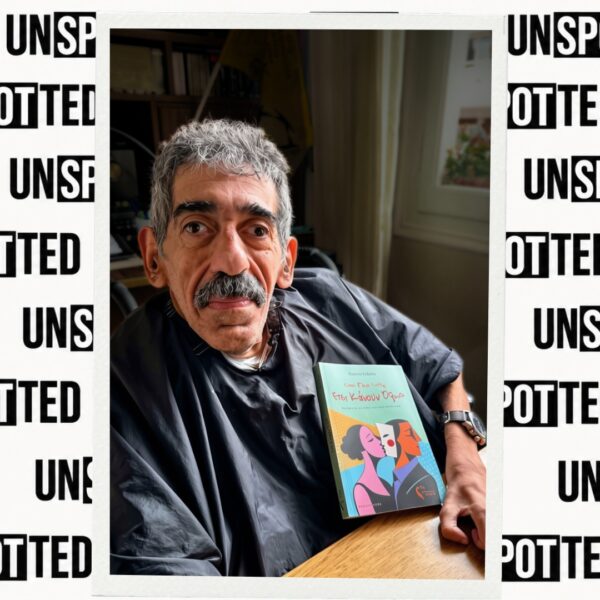
Stratis Galanos was born in Athens in 1968 and lives in Nea Ionia. He has had quadriplegia since birth and served as a member of the Audit Committee of the Panhellenic Association of Paraplegics (PASPA).
He studied Law at the University of Athens, graduating in 1991. He speaks four languages: English, French, Italian and Spanish.
He initially worked as a lawyer (1993–1996), subsequently as a secretarial support employee at ANT1 (1996), and finally as an administrative employee at the Athens Water Supply and Sewerage Company (EYDAP), from 1997 until his retirement in 2012.